




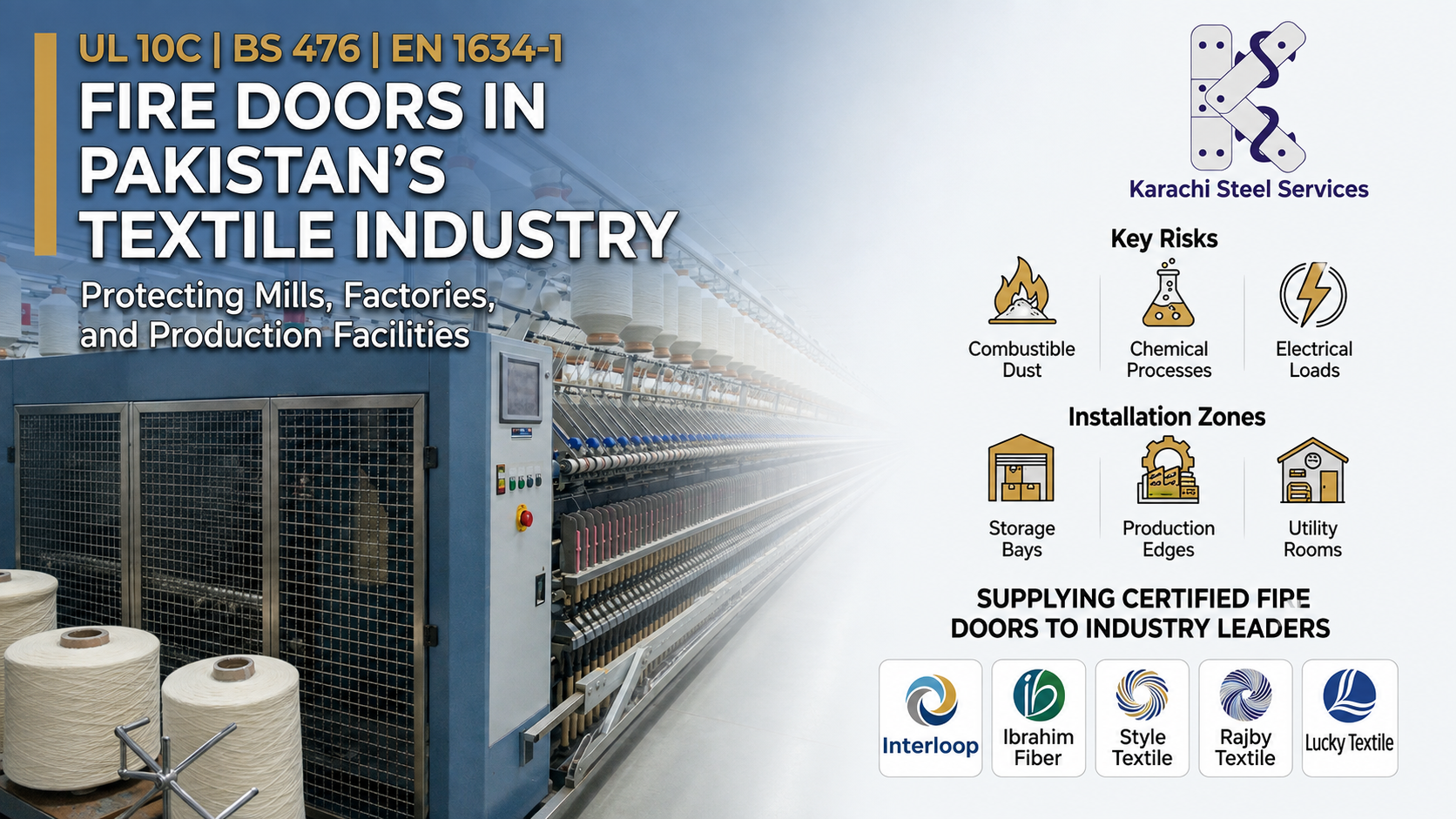
Pakistan’s textile industry is the backbone of its export economy — and one of the most fire-intensive industrial environments in the country. Spinning halls filled with cotton fibre, dyeing and finishing units running high-temperature chemical processes, storage bays packed with finished fabric, and electrical infrastructure operating at industrial scale all contribute to a fire risk profile that demands serious compartmentation engineering. A single uncontrolled fire in a textile facility can destroy millions in machinery and inventory, halt export contracts, and put hundreds of workers at risk simultaneously.
Karachi Steel Services is the fire door supplier of choice for some of Pakistan’s most prominent textile manufacturers. Our completed projects include Interloop, Ibrahim Fiber, Style Textile, Rajby Textile, and Lucky Textile — companies that collectively represent a significant share of Pakistan’s garment, hosiery, and fabric export capacity. These clients specified KSS because our UL 10C, BS 476, and EN 1634-1 certifications satisfy the fire safety requirements of their international buyers, their insurance underwriters, and their own internal safety standards.
The Specific Fire Risks in a Textile Facility (UL 10C | BS 476 | EN 1634-1)
Cotton fibre dust is highly combustible. In a spinning or carding hall, the accumulated dust in the air and on surfaces creates a fire load that ignites rapidly and spreads faster than almost any other industrial environment. A fire that starts in a cotton processing area can reach adjacent zones within seconds — making fire compartmentation at every transition point between production areas an absolute requirement.
Dyeing and finishing plants present a different risk profile. Chemical dyes, fixing agents, and finishing compounds are stored in quantity and used at high temperatures. The combination of flammable chemicals and open heat sources makes the fire risk in a dyeing plant comparable to a pharmaceutical solvent area — high ignition potential, rapid spread, and significant consequences if not properly compartmentalised.
Generator rooms, electrical distribution panels, and compressor rooms in large textile facilities carry substantial electrical loads that represent ignition risk. These must be individually enclosed with fire-rated doors that contain any electrical fire before it reaches the production floor.
What International Textile Buyers Require (UL 10C | BS 476 | EN 1634-1)
The major international brands that Pakistani textile manufacturers supply — H&M, Zara, Primark, Gap, and others — conduct their own factory audits as a condition of maintaining supplier relationships. These audits include fire safety assessments that check for certified fire door installations, documented door schedules, and evidence of regular inspection. A factory without certified fire doors risks losing its buyer relationship regardless of how competitive its pricing is.
Interloop, as a supplier to some of the world’s largest athletic wear brands, maintains fire safety standards that exceed the minimum requirements of Pakistani building codes. The KSS fire door installations at Interloop facilities are part of a comprehensive fire safety infrastructure that allows the company to pass international buyer audits without exception.
Key Installation Zones in a Textile Factory (UL 10C | BS 476 | EN 1634-1)
The boundary between the production floor and any office, warehouse, or utility area requires a fire door. In a large textile facility like those operated by Ibrahim Fiber or Lucky Textile, this means fire doors at dozens of internal boundaries — each one a rated assembly with auto-closing hardware and smoke seals.
Fabric and yarn storage areas require fire doors with a minimum 90-minute rating. The fuel load in a textile storage area — densely packed synthetic and natural fibre products — is among the highest of any industrial storage environment. Style Textile and Rajby Textile both specified 90-minute assemblies at their primary storage zone entries as part of their fire safety upgrade programmes.
Generator sets and transformer rooms within textile facilities must be fire-compartmentalised to prevent an electrical fire from reaching the production floor. These rooms typically require 90-minute to 120-minute rated doors depending on the transformer rating and proximity to combustible materials.
The Louvred Door Consideration in Textile Facilities (UL 10C | BS 476 | EN 1634-1)
Textile facilities use ventilation extensively — cotton dust management, temperature control in dyeing plants, and general air movement all drive the use of louvred steel doors throughout the facility. Karachi Steel Services manufactures both fire-rated solid steel doors for compartmentation requirements and louvred steel doors for ventilation applications. The two must never be confused — a louvred door on what should be a fire-rated opening is a critical safety failure.
The KSS Record in Pakistan’s Textile Sector (UL 10C | BS 476 | EN 1634-1)
Our fire door installations at Interloop, Ibrahim Fiber, Style Textile, Rajby Textile, and Lucky Textile represent some of the most demanding industrial environments in which our doors operate. High ambient temperatures, cotton dust, chemical exposure, and constant heavy-duty usage test every aspect of a fire door’s construction. Our doors are manufactured using high-grade galvanised steel with rockwool and ceramic fibre core insulation — specifically engineered for Pakistan’s industrial conditions.
For textile manufacturers and factory developers across Pakistan, contact Karachi Steel Services at 187 Nishter Road, Garden West, Karachi.